Wednesday, January 23, 2013

Marionette gets a beautiful new cockpit and more

Each new job that comes from the shop has it's own particular challenges and changes the atmosphere and feeling of the shop.  It may seem simple but with the coming and going of each boat we adapt to the particular needs of each job.  We arrange and rearrange equipment, set up new staging and adapt our surroundings to the task at hand.  With Marionette in the shop, I felt much smaller in stature than normal. She draws 7 feet and her spacious interior was almost overwhelming and the amount of light inside the cabin was startling.

This Kettenburg 50 lived for many years in Los Angeles near where she was built. During this time she was attacked by termites who made a mash out of the cockpit area.  Work completed during this phase of her time in the shop included new teak cockpit deck, new sepelle coamings,  repair of a rotten house side, and the removal and replacement of the cockpit sides and rotten hatches.  The termites had eaten across the under the cockpit and had compromised the framing that supports the rudder!


All  5 Photos above by David Whitaker

We were lucky and happy to have David Whitaker as guest carpenter on this job.  He worked away steadily and took some very nice process pictures.  The Maritime Northwest climate gave him a cool respite from the drought of the central states.


Marionette is  the largest sailboat we've had in the covered area.  She stuck out of the tent with mast still stepped although with the rig slackened. This set up is in the lee of the prevailing wind but with gusts over 50 knots  occurring during this work period, we were glad for the large section of the mast and the extra boat stands in place below the hull.


Pattern of the cockpit perimeter
Teak all laid out
Vacuum Pump in action

Deck Complete

Every once in a while a job brings the opportunity to be awed by the magnificence of a special piece of wood.  This time it was a live edged 2"x 24'x 22' boule, 142 board feet of sepelle!  All I could think was magnificent dining room table in a grand hall or my own small dining area!  The depth of figure in this wood is mesmerizing when finished.

Ping Pong paddle for scale

                                           
Detail of coamings, sappelle resawn and matched, each side.

Marionette was purchased in California and came up the coast on her own power.  She was sailed around the San Juan Islands this summer and finished that part of her trip at the Port Townsend Wooden Boat Festival before coming to Anacortes for the cock pit work.  When the work was completed,  James, Pat, and Andy returned her home to Port Ludlow by way of Port Townsend.                            


Example of the improvement.  Photo, David Whitaker

We expect to see Marionette again this year for further work including painting, sistering a few cracked frames,  etc.... All part of the vessel's maintenance and up grade program.

Monday, November 19, 2012

Pescawa's Re-launch


Pescawa hit the water on September 12, 2012 after being on land for 4 years or more.  The day was auspiciously pleasant with much excitement and anticipation.  As one might imagine, extra attention was paid to having two important pieces of equipment in good working order.  Jim Rovang of  Rovang Marine made sure that the two bilge pumps were powered up to go, as water was expected to steadily seep into the seams due to the boats extended dry period.  Owner David Waterman was mostly smiles the whole time, if he was nervous he wasn't showing it!

David Waterman preparing the hull for paint

After sitting in the sling for couple hours Pescawa was towed to slip where she sat overnight, her seams adjusting and swelling as the pumps gradually slowed their duty.


Shiny new prop and fresh paint

Caulking and filling seams with putty


Pescawa's original cabin and doorway

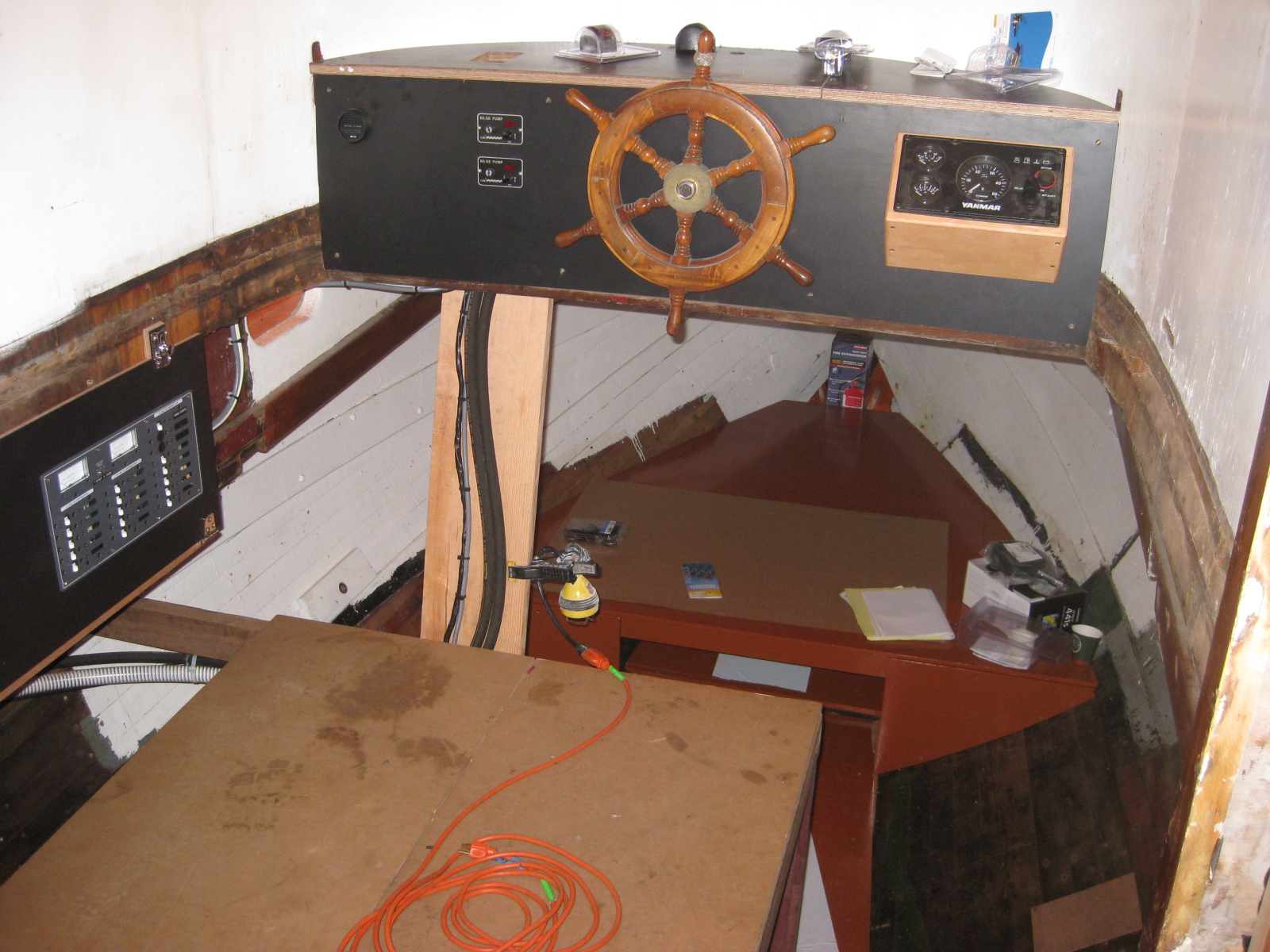
Beside the cabin extension, this latest slate of work included: caulking in the stern, bumping the cotton and repaying it,  phase one of the interior remodel, hull paint, all new wiring, new instrument panel, and new Yanmar 120 hp engine, shaft, propeller, and 4-1 reduction gear.
To see previous work and a good picture of how she looked before the work began, please visit  Pescawa 2011.
Preparing to rebuild and extend cabin

Frames and purple heart sill of  house extension dry fit

The posts, knees, braces, cabin top beams lain out and painted before final installation
First trip to Fuel Dock with new engine
Helm station with new electrical panel to the left


Monday, September 17, 2012

The Origami Boat

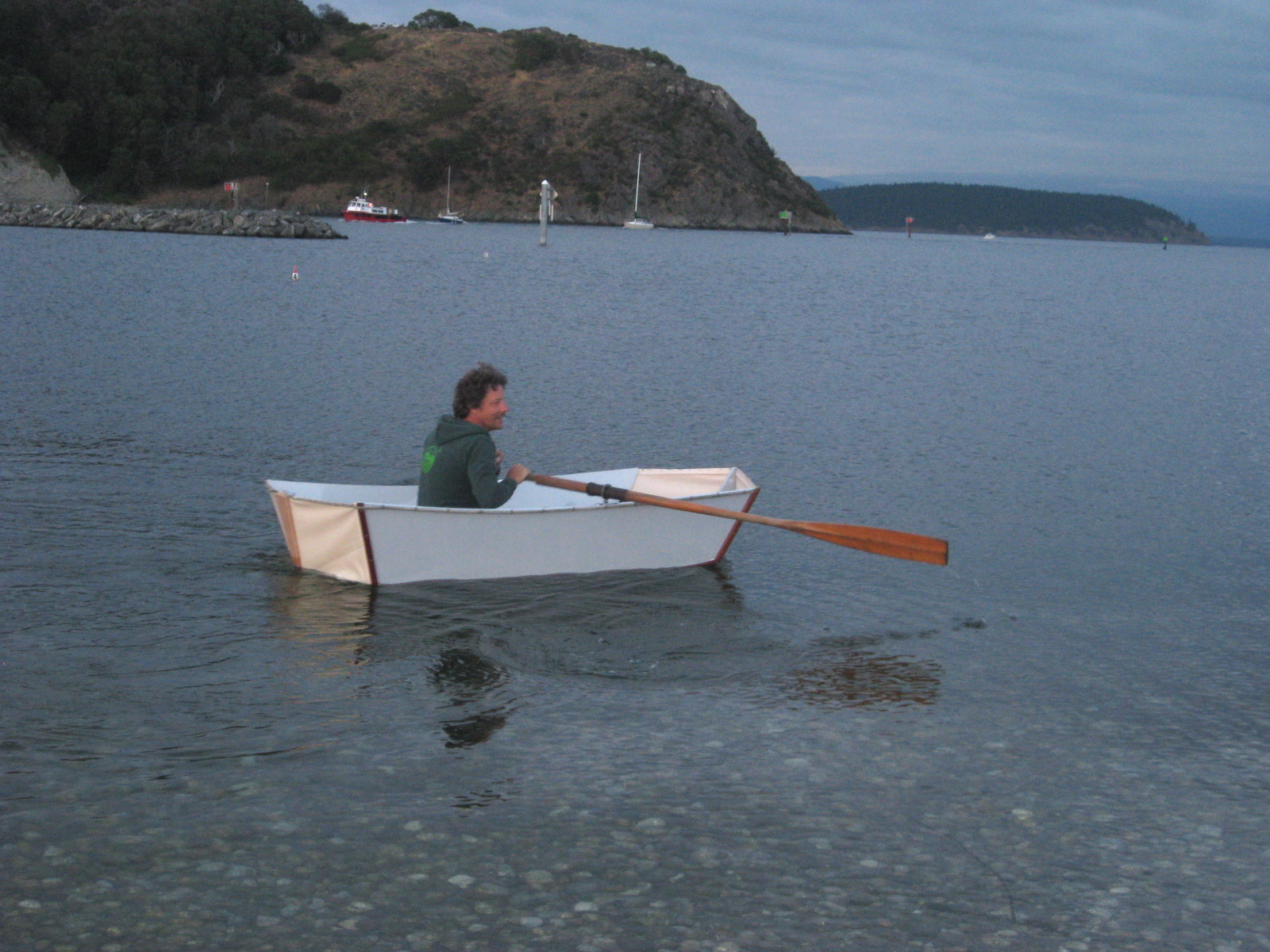
Emerald Marine Carpentry launched the newest member of it's fleet, a folding Origami boat.  This boat is quickly ready to row, can be easily rigged for sailing, set up for a small outboard motor, or equipped with a peddle power outfit.  This smart little vessel gets tucked up into a handy little package for easy storage.  To purchase the design and materials was about $250.  The finish weight is 44 lbs.  For us, it is quickly set up on the cabin top and lauched over the rail.

Number one goal achieved, low profile, high visibility from cockpit.


Stem, Stern, and Keel
Set up before the truck tarp skin was added

The overcast but pleasant summer Sunday evening was perfect for the first splash and inaugural row.  The design is from Woodenwidgets founder Robin Benjamin.  Check out his web link below.  The designs are fun and intriguing.  There are numerous videos online of these handy little boats rowing and sailing.  One of the most attractive boats is the nesting dingy Stasha.  She only weighs 22 lbs and from videos posted, looks to sail quite well.

Set up in Seconds!


Demonstrating stability: So useful for getting into and out of with a high free-board sailboat.


We found our little boat to be as stable as we would like for getting in and out of boats with high freeboard or onto docks. One can step near the sides and not tip. Worries that rowing into the wind with some moderate chop were not tested on our week long vacation.  Time will tell, although we think she'll do quite well.
We enjoyed our tender to Windsong on a week sailing!

Wooden Widget Website

P.S. so sorry about the mis-publishing of a very incomplete post.  Pescawa's Relauching will be forthcoming!


Wednesday, August 29, 2012

Teak Decks, Cabin Sole: Construction and Installation

Methods and Techniques

There are traditional laid teak decks and a more modern method which involves vacuum bagging new decking panels over an existing deck .  When Emerald Marine employs the modern technique, we  construct our panels made to patterns from the boat in our shop. We have also installed panels made by Teak Decking Systems and employ their products in making our custom panels.   Boats we've decked include a Grand Banks '36, a Northern Marine '64, and a long distance steel cruising yacht, built on an extended tuna fishing hull.  As seen at the bottom of this entry, we have also constructed a custom teak and maple cabin sole for as part of a custom interior on a  37' Nordic Tug.

Here is a panel  laid up on scrim. The seams will be filled with black caulk and  sanded before taking it to the boat


The finished is panel ready for installation


These decks were laid on plywood while in the shop
replacing the original Grand Banks construction
teak deck
The Grand Banks bow showing the seams of the panels
under the margin boards beneath the cleats


Here a panel has been installed.
The adjacent area prepared for the next 'bag
Vacuum bagging technique set up

Ready for final caulking
between the panels and the covering boards


For the cabin sole of Gandalf, a 37 foot Nordic Tug, Emerald Carpentry's James McMullen skillfully constructed solid tongue and groove teak and maple flooring and carefully fit it around furniture and hatches.


Thursday, August 2, 2012

Small Wood Boat Adventure in Barkley Sound


James McMullen of Emerald Marine Carpentry and three friends took their love of beautiful, small rowing and sailing craft for a week trip exploring the islands and beaches of Barkley Sound on Vancouver Island.  Enjoy this post on the Wooden Boat Forum!

Open Wood Boats, Row and Sail Barkley Sound


Tuesday, July 3, 2012

Historic Pacific Northwest Troller- Francis Fredette's Pescawa

Well known Canadian boat designer and nautical sage, Francis Fredette built Pescawa in Esquimalt Harbor on a scow barge in 1939 for himself. Fredette with a long and storied life spent much of his days seeing the world by water.  It's easy to be charmed by the story of this man.  It begins having been both lured into and warned off by the romance of maritime life by a favorite uncle. After his first adventure as a cabin boy on a sealing vessel, his father recognized his seamanship proclivity and aptitude, allowing him to become an apprentice shipwright rather then pursuing scholastics. He made steady progress learning the trade.  Eventually economic hardship forced him to leave Victoria following work fishing cod, more sealing, building Bristol Bay boats in Seattle, and a stint in the Merchant Marines during WW1.

Just before the journey to Emerald Marine
Among his adventures, Fredette, being dedicated to correct maritime conduct, clandestinely escaped a nasty Captain and murderous first mate. Later, as part of a hardy crew, he survived with 32 others on a life boat for 24 days after a lightening strike turned one ship into a floating bomb.  The men washed ashore in the Philippines. When he recovered his health he returned home to his family who had heard of no survivors from the lost ship, and took him for lost.  Pescawa was to be a turn of career for Fredette.  Equipped with the lore and support of fellow fishermen he decided to try his hand at harvesting from the sea.

After a brief, unsuccessful foray into fishing, Francis sold the boat and went back to building and designing.  His wife Irene had strongly encouraged him to pursue his creative talent.  He has many designs to his credit: pelagic sealing boats, yachts, handy day sailers, fishing vessels and cruisers. Near the end of his career he encouraged the shipwright skills in others and trained green shipwrights in Nanaimo.
Aft shot of the 'cruising stern'

Pescawa's most unique aspect is what Fredette named a cruising stern: a combination of a double ended and a round stern.  It is built both staved  and in lifts to form a rounded canoe-like stern. This particular design was later used by designer Edwin Monk.  Pescawa's owner, David Waterman feels strongly about preserving this salty boat so rich in personal history for Fredette.
While the boat was in Dave's back yard he painstakingly removed the foamed in fish hold, tanks  and the tired Lehman engine.  Working with Andy, he refastened hull planking and they began rebuilding the clamps that were cut when the hold was fit. The hull was inspected and a restoration plan agreed on. Over all the vessel was in pretty good shape considering her age. Her double sawn yellow cedar frames and tight old grown fir planking undoubtedly contributed significantly to her longevity. A new 120 hp yanmar engine with a 4:1 reduction gear was purchased and put in the boat, ready to be fit to new engine beds.


In fall of 2011, the boat moved to  Emerald's shop, work continued shoring up the stern. The entire assembly had fallen away from the hull over time.  New floor timbers, frames  and clamps were fit  in that area. Going forward, the break beam at the deck was  iron sick and the laid deck was tired.  The deck was removed, the deck beams replaced or repaired and the uppermost frame ends, which double as the stations, replaced on both sides.


A new deck was laid with two layers of 12mm plywood, glue to each other and rabbeted in to new covering boards. The fish hold opening was cut down by half to accommodate the cabin extension.  


This spring a second set of work began including extending the cabin wheelhouse, building new engine beds and bolting down the engine, installing tanks and batteries.  Attached to the cruising stern are two tow bollards perhaps  to move logs around in BC.  All the electrical and hydraulic systems will be replaced. The shaft and prop are new but the original rudder is still serviceable and will wait to be replaced in the future.  After the current structural work is completed, the wheelhouse will be lengthened enough for a head and shower. Forward and below will be a v-bearth and galley.  The overall vision is to keep it simple and not loose the spartan workboat feel that is central to the history of this boat.

Visit this blog again to see how the work is progressing.


The Watermans have plans to enjoy the local waters of the San Juan Archipelago and Canadian Gulf Islands. Retirement living plans include heading into the inlets and coves of British Columbia on the way to Alaska, taking time to meander and spend more quality time in the peaceful fiords.  If all goes well, greater cruising plans and dreams include the Panama Canal, east coast St. Lawrence Waterway and into Ontario!  Adventure calls!